


In 2026, video infrastructure is no longer a supporting utility; it has become a foundational component of enterprise operations. From telehealth consultations and financial services to government communications and global collaboration, organizations increasingly rely on secure, scalable and resilient video ecosystems to maintain operational continuity.
Selecting the right infrastructure is no longer simply about comparing features. Enterprises must evaluate long-term scalability, data sovereignty, compliance obligations, operational resilience and total cost of ownership (TCO).
The right architecture not only supports communication but also strengthens security posture, protects institutional data, and enables future innovation.

Aligning Infrastructure with Institutional Requirements
Organizational Priorities
Determine whether the primary objective is:- Reducing operational overhead
- Enabling secure global collaboration
- Improving compliance readiness
- Maintaining strict jurisdictional control over sensitive data.
Internal Technical Capabilities
Assess whether internal infrastructure and operations teams can independently manage private environments or whether a managed sovereign infrastructure provider is required.Participant Parity
Modern systems must provide a consistent experience. This aligns with broader customer experience trends in 2026, where reliability and quality are now operational necessities rather than optional enhancements.Evaluating Deployment Models: Control vs. Convenience
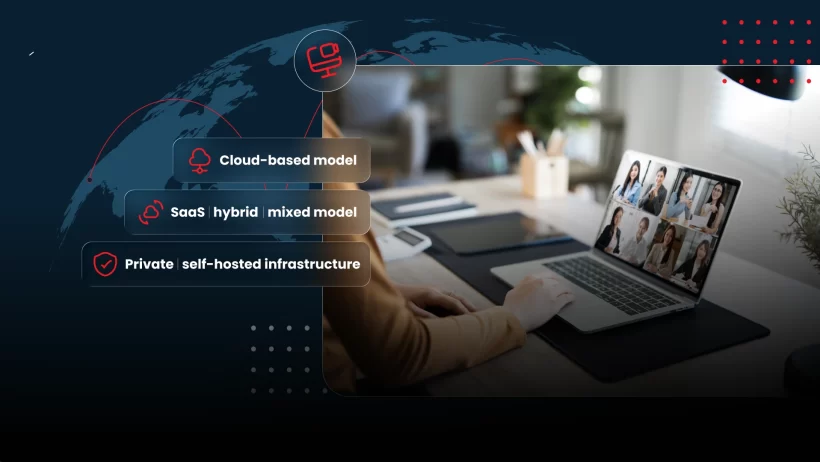
The deployment model an organization selects will directly influence security, compliance, operational flexibility and long-term financial sustainability.
1. Private Cloud and Sovereign Managed Infrastructure
Highly regulated industries are rapidly adopting sovereign managed infrastructure as the preferred model. Organizations that require strict jurisdictional control over communications data gain the most from this approach. Your team maintains direct governance over data residency obligations and infrastructure decisions – without depending on shared cloud environments.
2. Software as a Service (SaaS)
Vendors operate public SaaS platforms under a shared responsibility model, which enables fast deployment. Enterprises should carefully assess whether these environments align with their governance requirements, particularly regarding AI training data exposure and escalating per-user costs.
3. Self-Hosted / On-Premise Infrastructure
Your team manages self-hosted infrastructure to achieve maximum autonomy and complete control over hardware and communication data. Organizations running air gapped environments and defense related operations benefit most from this model.
Why Altegon is the Strategic Choice for 2026
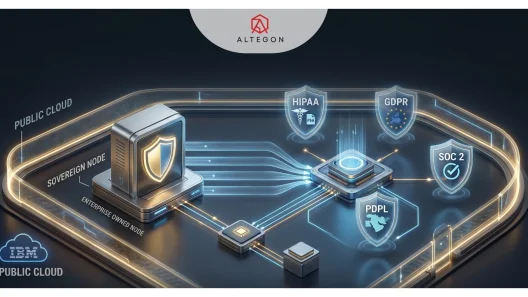
Altegon Connect Sovereign Node helps enterprises balance the operational flexibility of SaaS with the control and governance advantages of private infrastructure.
Rather than remaining dependent on third-party ecosystems, organizations gain greater ownership over their communication environments, security policies and infrastructure strategy.
Key advantages include:
Infrastructure Ownership
Altegon enables organizations to transition from volatile subscription-driven operating costs toward more predictable infrastructure investment models, improving long-term financial visibility.
AI-Ready Architecture
Altegon platforms are engineered with AI-ready infrastructure capabilities, including integrated transcription and indexing workflows that reduce reliance on external third-party services. Sovereign Node gives infrastructure teams the control they have always needed – without the trade-offs that come with shared cloud environments.
Sovereign AI Alignment
Organizations maintain greater control over sensitive communication data, ensuring enterprise information is not exposed to public large language model (LLM) training environments.
Modular Infrastructure Design
Flexible deployment architectures allow enterprises to align communication systems with internal operational requirements, governance frameworks and branding standards.
Learn more about Altegon enterprise infrastructure.
Conclusion - Making the Final Decision
Selecting enterprise video infrastructure in 2026 requires more than evaluating feature sets or short-term deployment costs. Organizations must assess how infrastructure strategy supports long-term operational resilience, regulatory compliance, data sovereignty, and AI readiness.
As communication systems become increasingly central to enterprise operations, infrastructure decisions now directly influence security posture, scalability and institutional control over sensitive data.
Whether deploying sovereign managed infrastructure, private cloud environments, or self-hosted systems, enterprises should prioritize architectures that provide predictable cost structures, low-latency performance and full governance over communication workflows.
Organizations that invest strategically today will be better positioned to adapt to evolving compliance requirements, AI-driven collaboration and the growing demand for secure digital communication ecosystems.
Book a Demo with our solutions team.
FAQs
Which deployment model is considered the most secure?
Self-hosted and private cloud environments are generally considered the most secure because organizations maintain direct control over infrastructure, governance policies and data access.
Does enterprise video infrastructure require a dedicated IT team?
It depends on the deployment model. SaaS environments typically require minimal operational management, while private or self-hosted infrastructure may require internal expertise or managed infrastructure support partners.
Why is pilot testing critical in 2026?
With increasing adoption of 4K collaboration, AI-powered workflows and distributed work environments, pilot testing helps infrastructure teams validate network performance, latency and participant experience before full-scale deployment




Comments are closed.