
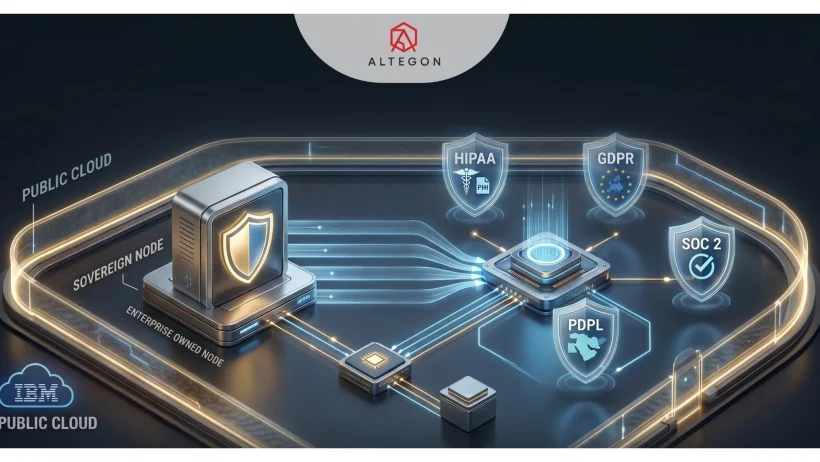
Compliance is no longer just about paperwork; it has become a critical technical requirement. As global data protection laws get stricter, with real-time monitoring and enforcement, many businesses are realizing that traditional SaaS platforms are no longer enough. The main challenge comes down to data control. When your data is handled on third-party servers, you lose full control and the ability to guarantee complete privacy and security.
The Shift from SaaS Trust to Sovereign Architecture
For years, businesses relied on SaaS platforms based on trust using agreements like SLAs and BAAs to manage risk. But with increasing data breaches and growing conflicts between global regulations, this model is no longer sufficient. In 2026, the focus has shifted. Businesses now need sovereign communication infrastructure giving them full control, security, and ownership of their data.
Founder & CEO, Altegon
Why Traditional SaaS Models Are Failing
SaaS platforms have long been the standard for managing compliance, but today, that model is struggling to keep pace with evolving threats:
- Skyrocketing Breach Costs: The average cost of a data breach has reached $4.88 million, a 10% increase from the previous year (IBM Cost of a Data Breach Report).
- Cloud Vulnerability: Cloud-based intrusions rose 37% year-over-year, highlighting the risks of shared public environments (CrowdStrike Global Threat Report 2025).
- Widespread Exposure: 80% of organizations experienced at least one cloud-related breach in the past year (SentinelOne Risk Report).
- Record Compromises: The U.S. recorded 3,322 data compromises in the last year, a 79% increase over five years (ITRC Data Breach Report).
- Regulatory Penalties: According to the 2024 Verizon DBIR, nearly one-third of breaches now result in direct regulatory fines or compliance penalties.
Unlike traditional video APIs that route sensitive conversations through shared public cloud environments, a sovereign node resides within your private perimeter. This ensures that the data path, media processing, and encryption keys are owned exclusively by the enterprise. For a deeper dive, see our Sovereign Infrastructure 2026 Enterprise Data Standard guide.
Modern Enterprise Data Standards
Enterprises are now moving toward sovereign communication infrastructure to achieve:
- Full Data Path Custody: Maintain control over every media packet.
- Local Data Residency: Meet strict national residency requirements.
- Public Cloud Decoupling: Eliminate reliance on shared third-party routing.
- Audit Independence: Generate logs for regulators without vendor delays.
All-in-One Compliance: HIPAA, GDPR, PDPL, and SOC 2
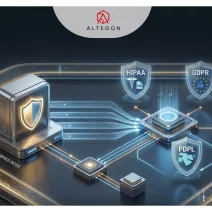
Here’s how our infrastructure meets the technical requirements of major global regulations.
2026 Regulatory Alignment Table
| Regulation | Core Requirement | Sovereign Node Infrastructure Response |
| HIPAA | Technical PHI Safeguards | On-prem/VPC media termination; no external PHI transit. |
| GDPR | End-to-End Localization | Fully localized signaling and metadata processing within the EU. |
| PDPL | National Residency | Environment-agnostic deployment in local KSA/UAE regions. |
| SOC 2 | Controlled Environments | Continuous monitoring via customer-owned telemetry and VPC isolation. |
| DORA | Operational Resilience | Decoupling from third-party SaaS downtime to ensure continuity. |
1. HIPAA and HITRUST (Healthcare)
Healthcare providers face aggressive audits prioritizing technical proof of data isolation. Under the HIPAA Security Rule, transmission security is paramount. The Altegon Sovereign Node ensures Protected Health Information (PHI) never touches an external server. Because the node lives in your VPC, media termination happens locally.
2. GDPR and the EU Data Boundary
As the European Health Data Space (EHDS) continues its phased rollout through 2026, the Sovereign Node enforces jurisdictional sovereignty by locking the communication engine within EU-based infrastructure. This significantly reduces exposure to key risks associated with the U.S. CLOUD Act.
3. PDPL (Middle East Resilience)
The Saudi Arabian and UAE Personal Data Protection Laws (PDPL) require critical national data to be processed on local soil. Altegon’s node is environment-agnostic, allowing deployment on local providers like STC Cloud to guarantee true Local Data Residency.
4. SOC 2 Type II (Security & Trust)
Beyond healthcare and regional laws, SOC 2 compliance requires organizations to prove they have a controlled and monitored environment. By hosting the Sovereign Node in your own VPC, you gain the ability to apply your own security controls and continuous monitoring, making the audit process seamless and transparent.
5. DORA (Financial Resilience)
The Digital Operational Resilience Act (DORA) requires financial entities to manage third-party ICT risks. By using Altegon, firms reduce their “concentration risk” on major SaaS providers, ensuring that their communication stack remains operational even if a global SaaS vendor faces an outage.
How Altegon Supports Your Compliance Needs
Altegon provides the core infrastructure that turns digital sovereignty into a practical, scalable solution. Our Sovereign Node integrates into your existing enterprise setup, ensuring:
- Data never leaves your controlled environment.
- Encryption keys remain enterprise-owned.
- Media processing happens locally.
- No exposure to external infrastructure risks.
The Role of Sovereign AI in Communication
Many organizations realize too late that their video platform is sovereign, but their AI isn’t. Altegon’s infrastructure allows AI agents to run directly on the node. This means transcription and summarization happen within your secure perimeter, ensuring sensitive data is never used to train public LLM models.
Conclusion!
The shift to sovereign infrastructure is no longer optional. As compliance moves toward real-time technical enforcement, true control over data is the foundation of regulatory resilience. With Altegon’s Sovereign Node, you gain full ownership of your communication infrastructure while meeting global standards with confidence.
Ready to take control of your data and communication stack?
Connect with Altegon today to deploy your Sovereign Node and build a secure, future-ready foundation.
FAQs
1. Does the Sovereign Node require a specific cloud provider?
No, the Altegon Sovereign Node is environment-agnostic. It can be deployed in private clouds, public cloud VPCs (AWS, Azure, GCP), or on-premise bare metal servers.
2. How does the node handle AI transcription without violating privacy?
The node features “On-Node AI,” meaning transcription and summarization happen within your secure perimeter. Data is never sent to external LLM providers.
3. Is the Sovereign Node more difficult to manage than a standard API?
While it offers enterprise-level control, Altegon provides a managed infrastructure approach. We handle the orchestration and updates, while you maintain full data custody.