The global AI landscape is undergoing a fundamental transition. Text-based interfaces once the dominant medium for interacting with large language models are rapidly being displaced by real-time, multimodal communication. As enterprises accelerate digital transformation agendas, voice and video are emerging as the next major battleground for AI-driven applications, reshaping customer engagement, operational workflows, and product innovation.
This shift is not incremental. It represents a structural evolution in how organizations deploy and scale intelligent systems.
Why Text-Based AI Is No Longer Sufficient for Enterprise Needs
Traditional chat-based interfaces introduced automation and scalability but created inherent friction:
- Users are forced to translate intent into structured written commands.
- Contextual depth is limited to textual interpretation.
- Visual inputs must be manually described to be processed.
- Accessibility gaps persist for users with limited literacy or writing capabilities.
Therefore with the rise of speech-to-text systems, on-device models often lack robustness, resulting in accuracy issues and poor reliability across environments unacceptable in enterprise-grade workflows.
Modern enterprise use cases require speed, contextual depth, multimodal understanding, and real-time responsiveness at a level static text cannot provide.
Voice Is Becoming the Strategic Interface for AI
Global user behaviour has shifted toward immediate, conversational interaction. Enterprises now operate in markets where:
- Natural language input must be processed in real time
- Voice must support multi-turn reasoning
- Systems must handle complex, unscripted requests
- Latency must be measured in milliseconds, not seconds
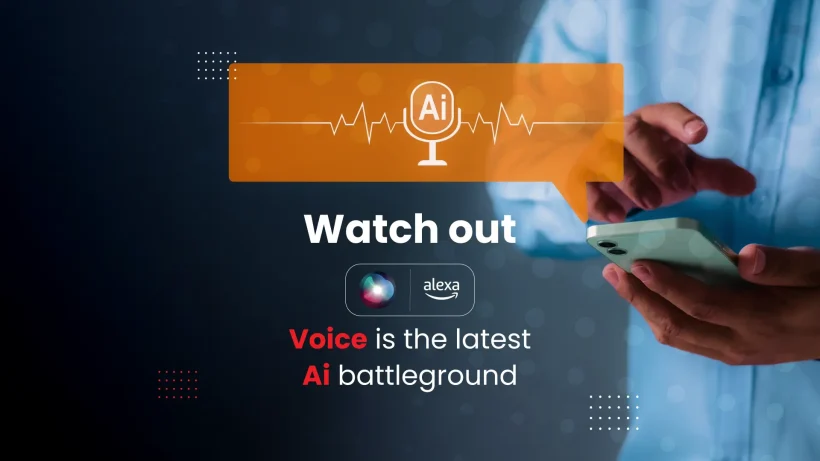
Consumers were first exposed to this interaction model through Siri, Alexa, and Google Assistant. However, the enterprise environment has outgrown these early-generation assistants. The need has evolved from scripted command execution to adaptive, context-aware dialogue systems.
Advancements in mobile hardware high-fidelity microphones, noise suppression, and dedicated neural processors have accelerated adoption. Voice-first experiences have shifted from optional enhancements to baseline expectations.
Legacy Assistants Are Not Built for Enterprise-Grade Complexity
Siri, Alexa, and Google Assistant introduced voice interaction to the mainstream but remain bound by architecture optimized for predefined, narrow tasks. Their limitations include:
- Rigid, intent-based frameworks
- Limited contextual memory
- Shallow reasoning capabilities
- Limited extensibility for enterprise integration
- Dependency on fixed command structures
With the arrival of real-time multimodal models, particularly those enabled by APIs like OpenAI’s Real-Time SDK, these assistants face competitive displacement. Modern agents can:
- Conduct multi-turn, context-preserving dialogue
- Make recommendations
- Infer intent
- Execute complex, interconnected actions
These capabilities mark a structural divergence from earlier consumer voice assistants.
The Technological Foundations of the New Voice Era
The transition from text to multimodal voice systems is powered by three foundational advancements:
1. Large Language Models (LLMs) with Multimodal Capabilities
Modern models:
- Maintain context over extended exchanges
- Understand semantic nuance
- Process parallel audio, text, and visual data
- Interpret emotional signals within speech patterns
These capabilities enable enterprise-grade applications such as automated support agents, training systems, workflow orchestration, and decision support tools.
2. Automatic Speech Recognition (ASR) at Enterprise Accuracy
Contemporary ASR systems deliver:
- Near-human accuracy in ideal conditions
- High resilience across accents, environments, and noise levels
- Adaptive learning mechanisms
- Real-time streaming performance
This reliability is essential for enterprise communication, operational automation, and high-volume customer contact centers.
3. Neural Speech Synthesis at Human-Like Quality
Modern TTS engines such as those developed by OpenAI, ElevenLabs, and Fish.Audio now support:
- Emotionally adaptive delivery
- Context-aware modulation
- Multi-voice consistency across sessions
- Fine-tuned control over tone and pace
These advancements allow enterprises to deploy voice agents that are brand-aligned, contextually appropriate, and capable of sustaining long-form dialogue.
Adding a New Dimension: Real-Time Visual Understanding
The introduction of real-time video and visual processing further differentiates next-generation AI systems from legacy assistants.
Computer vision models:
- Interpret facial expressions, gestures, and body language
- Track objects and movement
- Understand environmental context
- Extract complex scene-level information
This eliminates the need for users to verbally describe visual data, a major efficiency improvement for professional workflows across healthcare, field operations, education, and remote collaboration.
The Emergence of Multimodal Enterprise Agents
Next-generation enterprise systems are agent-first, not prompt-first.
These agents:
- Process voice, video, text, and contextual signals simultaneously
- Execute tools and APIs autonomously
- Provide proactive recommendations
- Retain memory across interactions
- Function as operational collaborators rather than informational search engines
For enterprises, this unlocks use cases such as:
- Multimodal customer service
- Autonomous onboarding and training
- Real-time monitoring and decision support
- Workflow orchestration
- Intelligent field collaboration
This shift fundamentally redefines digital interaction models.
Enterprise Challenges: Infrastructure, Scalability, Reliability
As organizations adopt real-time voice and multimodal interaction models, infrastructure requirements become significantly more demanding.
Key enterprise challenges include:
- Sub-100ms latency expectations
- Edge processing for reliability
- Multistream synchronization (audio + video + context)
- Scalable real-time data pipelines
- Adaptive bitrate streaming
- Server-to-client delivery management
- Varying device capabilities across global user bases
Frameworks like OpenAI’s Real-Time SDK deliver core model capabilities, but enterprises must build supporting infrastructure to ensure last-mile reliability.
Security and privacy become equally critical. Voice and video interactions generate highly sensitive data. Enterprises must adopt:
- Federated learning
- End-to-end encryption
- On-device inference where possible
- Transparent data governance models
Trust is now a strategic differentiator.
Preparing for the Next Phase of AI Interaction
The shift from text to voice and multimodal AI is not a trend it is an unavoidable evolution. Enterprises that continue to build text-first systems will face competitive disadvantage as customers demand:
- faster resolution
- deeper personalization
- contextual awareness
- more natural, efficient communication
Organizations that adapt early will benefit from improved engagement, operational efficiency, and service differentiation.
Case Study : 1
Global Multilingual Event & Native-Language Support
The Challenge
A global enterprise serving millions needed to make their large-scale live events truly inclusive. Language barriers and unpredictable engagement spikes were holding them back.
The Solution
With Altegon’s advanced Voice AI pipeline, they unlocked:
- Instant multilingual access for every session
- Real-time translation and interaction, even during massive traffic surges
- Natural, human-like conversations across diverse audiences
The Impact
Their events transformed from language-limited to borderless experiences, empowering participants to connect, translate, and communicate effortlessly in real time.
Case Study 2: Native-Language Video Meetings at Scale
Beyond large events, the company expanded Altegon’s capabilities into their internal and external collaboration workflows.
Now, teams across regions can join video meetings in their native languages, with the system handling voice translation, intent understanding, and multi-party conversation management.
This ability has become a globally deployed, real-environment-proven solution that now supports thousands of users daily.
Added Advantage: AI Note-Taker Integration
To enhance productivity, Altegon also integrated a lightweight AI note-taker pipeline.
This feature automatically:
- Generates meeting summaries
- Captures key points
- Syncs notes across tools
This ensures that multilingual communication isn’t just happening it’s also being documented with the same precision expected from enterprise-level platforms.
Wrapping Lines!
As the race for AI dominance shifts from text to voice, enterprises can no longer rely on traditional assistants like Siri and Alexa to deliver the responsiveness, accuracy, and real-time intelligence modern users expect. The new battleground is clear: intelligent, low-latency voice infrastructure that adapts to business workflows not the other way around.
Companies that invest in advanced voice AI today will lead tomorrow’s customer experience, automation, and communication standards. Those who wait will be left competing with outdated interfaces and fragmented user journeys.
This is exactly where Altegon becomes a strategic advantage.
With its ultra-low-latency voice and video engine, context-aware AI models, and enterprise-grade flexibility, Altegon empowers organizations to build natural, scalable, and high-performing voice experiences far beyond what consumer assistants were designed to handle.
In the new era of voice-driven AI, the winners will be the ones who choose technology built for business.
Altegon is ready to power that shift.