
Virtual meetings are no longer just a convenience; they are now a regulated environment where privacy, security and compliance define whether your organization is trusted or legally exposed.
As remote work, telehealth and global teams expand, regulators have moved from recommending best practices to enforcing strict technical safeguards. Organizations must now understand how two major frameworks HIPAA and GDPR can apply simultaneously to the same video call.
Research from Gartner predicts that by 2026, nearly 75% of the global population will have its personal data protected under modern privacy laws.
This guide explains how to meet HIPAA and GDPR requirements in 2026, what compliance-ready video platforms must provide, and how AI-driven tools can strengthen your security posture.
HIPAA Compliance: Protecting PHI in the US
The Department of Health and Human Services (HHS) has moved toward “Active Enforcement.” For virtual meetings, encryption is no longer the final step; you must prove Access Control and Auditability.
- The BAA (Business Associate Agreement): This remains the legal foundation. You cannot discuss patient data on a platform unless the provider signs a BAA, assuming liability for data protection.
- Mandatory MFA: Multi-Factor Authentication is a strict requirement for any user accessing ePHI (electronic Protected Health Information) via a video portal.
- Audit Trails: Platforms must generate cryptographically signed logs of every entry, exit and file share to be “audit-ready” for the OCR.
| Did you know? Always enable waiting rooms for virtual sessions and it prevents unauthorized participants from joining your meetings. |
GDPR Compliance: Privacy Rights for a Global Workforce
GDPR compliance in 2026 centers on “Data Sovereignty” and the “Right to be Forgotten.”
- Regional Data Routing: If an EU citizen joins your meeting, their metadata and video stream must stay within EU-approved ‘Adequacy’ zones. This is the cornerstone of data sovereignty and ownership, ensuring your organization maintains absolute control over where information lives and who can access it.
- The Right to Erasure: Unlike HIPAA, GDPR allows participants to request the deletion of their specific data (voice or likeness) from a recording without necessarily deleting the entire meeting.
- Informed Consent: In 2026, “implied consent” is dead. Platforms must provide explicit “Opt-In” prompts for recording or AI-summarization features.
| Tip: Use multi-factor authentication for all users – it’s required for HIPAA compliance and adds an extra layer of protection. |
Key Features of Compliance Video Platforms
By 2026, compliance video platforms are expected to offer an even more robust suite of features to meet evolving regulatory demands.
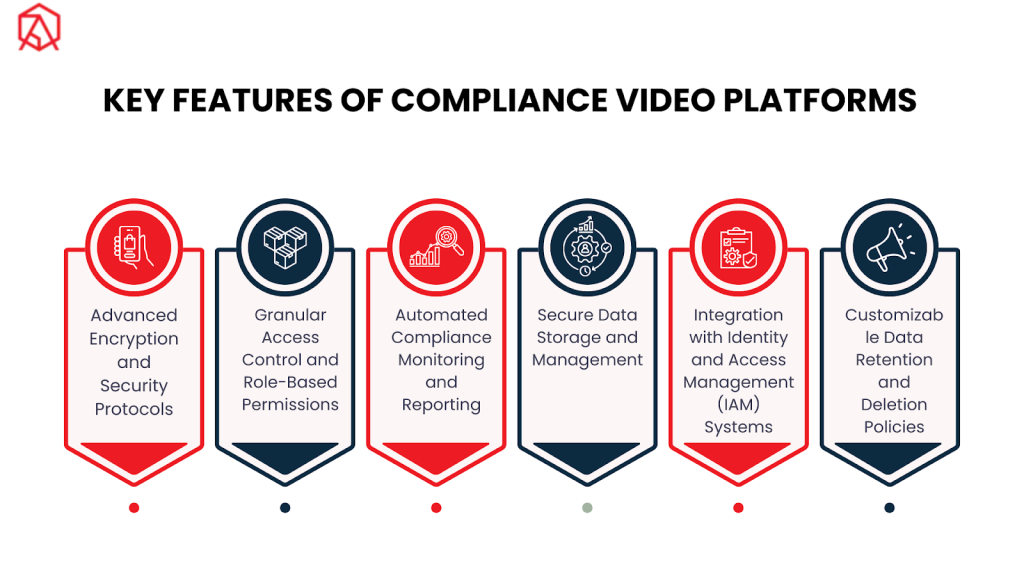
- Advanced Encryption and Security Protocols: Beyond standard end-to-end encryption, expect features like quantum-resistant encryption and advanced threat detection tailored for virtual environments.
- Granular Access Control and Role-Based Permissions: The ability to precisely control who can access, record, and share meeting content, with different roles having different privileges.
- Automated Compliance Monitoring and Reporting: AI-powered tools that can flag potential compliance violations in real-time and generate detailed audit reports.
- Secure Data Storage and Management: Cloud storage solutions that adhere to specific regional data residency requirements and offer robust backup and recovery protocols.
- Integration with Identity and Access Management (IAM) Systems: Seamless integration with existing organizational IAM systems to ensure secure authentication and authorization.
- Customizable Data Retention and Deletion Policies: Tools that allow organizations to set specific retention periods for meeting data based on regulatory requirements.
| Fun Fact By 2026, 75% of the world’s population will be protected under privacy regulations – that means most users are legally covered. |
HIPAA Rules for Virtual Therapy
In the context of video therapy, HIPAA (Health Insurance Portability and Accountability Act) is the bedrock of patient trust. To be compliant in 2026, you must master the four core video conferencing tips :
- The Privacy Rule: This sets the national standards for protecting medical records. In a video session, this means ensuring that no unauthorized person can overhear or view the session.
- The Security Rule: This mandates technical safeguards. For virtual health, this requires End-to-End Encryption (E2EE) and strict access controls (like MFA) to protect electronic PHI (ePHI).
- The Breach Notification Rule: If a session is intercepted or a recording is leaked, you are legally required to notify the affected individuals and the Secretary of HHS within strict timeframes.
- The Omnibus Rule: This is critical for 2026. It extends HIPAA liability to your Business Associates (BAs) the video platforms themselves.
| Did You Know? Peer-to-peer (P2P) connections reduce the “attack surface” of your video calls by sending data directly between participants. |
Distinguishing Covered Entities vs. Business Associates
A common point of confusion is who actually needs to comply.
- Covered Entities: These are the healthcare providers, therapists and clinics who directly provide care and handle patient data.
- Business Associates (BAs): These are the vendors you hire to help you run your practice. This includes cloud storage, billing services and most importantly your video conferencing platform.
A Covered Entity is only compliant if they have a signed Business Associate Agreement (BAA) with their video vendor. This contract ensures the vendor assumes legal responsibility for safeguarding the data passing through their servers.
Technical Standards for Compliance Video Platforms
If you are choosing a platform like Digital Samba or Altegon, it must meet specific technical benchmarks that align with the rise of digital sovereignty in 2026. In this landscape, security is defined by how well a platform isolates and protects user identities from external vulnerabilities.
- Peer-to-Peer (P2P) Connections: This ensures that video data travels directly between the doctor and patient, bypassing the vendor’s servers entirely, which minimizes the “attack surface.”
- Zero-Knowledge Encryption: The vendor should not have the keys to your “room.” Even if the platform’s database is hacked, your video sessions remain encrypted and unreadable.
- WebRTC Security: Using WebRTC for browser-based calls ensures that no vulnerable plugins need to be downloaded, keeping the patient’s device safe.
- Audit Trails: The system must automatically log every participant’s entry and exit time, providing a “paper trail” for federal auditors.
HIPAA vs. GDPR: Key Distinctions for Global Practices
For therapists serving international clients, “HIPAA-compliant” is not enough. You must also satisfy GDPR.
| Feature | HIPAA (USA) | GDPR (EU/Global) |
| Data Scope | Only Health Information (PHI) | All Personal Data (IP, Name, Face) |
| Breach Reporting | Up to 60 Days | Within 72 Hours |
| Consent | Standard Consent Forms | Explicit, Plain-Language Opt-in |
| Data Sovereignty | US-based storage is fine | Data must stay in “Adequate” zones (EU) |
How to Implement a Secure Workflow
Adding compliance into your existing website is the most professional way to handle sessions in 2026. Using an API or SDK allows you to host sessions within your own secure portal.
The 2026 Setup Checklist:
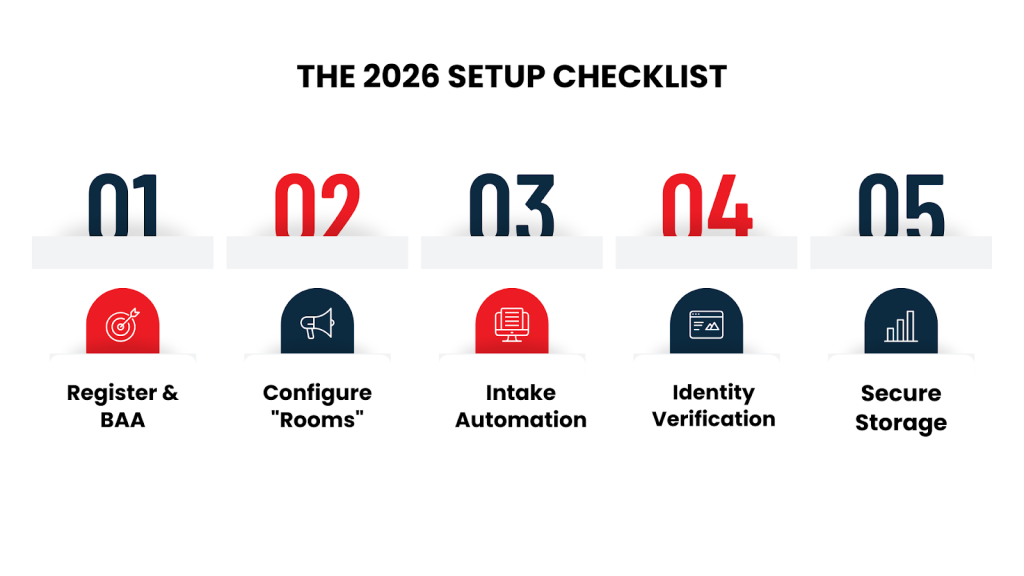
- Register & BAA: Sign up for a platform that offers a pre-signed BAA for healthcare users.
- Configure “Rooms”: Set up virtual rooms with “Waiting Room” features enabled so no one can join without your permission.
- Intake Automation: Use digital forms to gather informed consent before the video link is even sent.
- Identity Verification: Use the platform’s built-in tools to verify the patient’s ID at the start of the call.
- Secure Storage: Ensure any recordings are saved to a HIPAA-compliant data center with auto-expiry dates.
Final Thoughts: The Future is Private
Compliance is the cornerstone of professional integrity. Navigating HIPAA and GDPR isn’t just a safeguard against $10.22 million breach penalties; it’s a commitment to client trust. By leveraging Altegon’s Zero-Knowledge architecture and self-hosted security, organizations can ensure total data sovereignty and “Privacy-by-Design.” By leveraging Altegon’s Zero-Knowledge architecture, organizations can ensure total data sovereignty. As we’ve learned from recent voice AI infrastructure lessons, the future of secure communication depends on localized, secure processing that doesn’t compromise on speed or privacy. Ultimately, the most successful firms in this digital-first era will be those that transform complex regulatory mandates into a powerful competitive advantage by providing a truly safe environment for every virtual interaction.