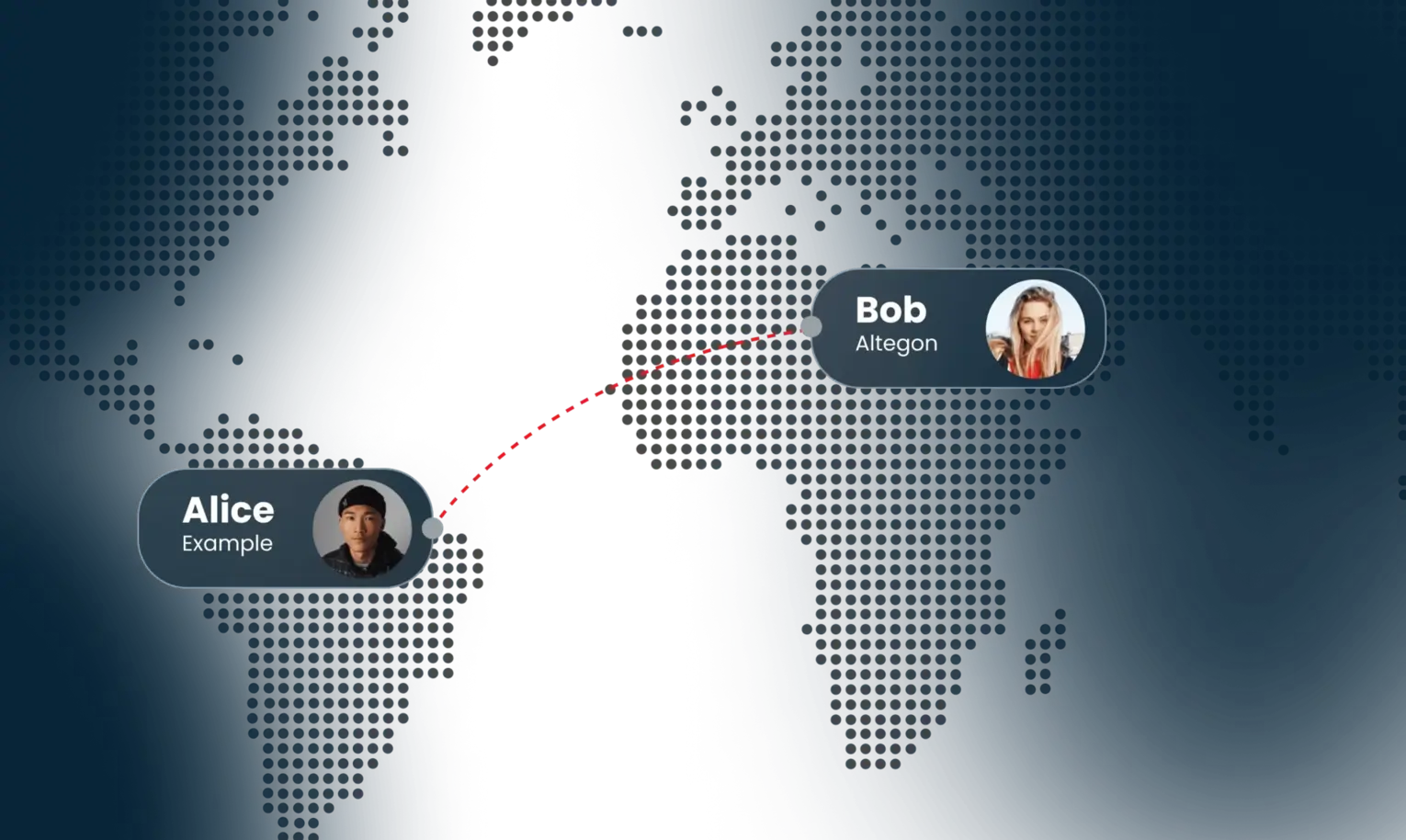
In the digital age, the “world is flat,” yet communication remains jagged. Despite the collapse of physical borders through high-speed internet, a massive, invisible wall remains: the Language Barrier. For decades, global enterprises have settled for clunky, third-party translation or expensive human interpreters that slow down the pace of innovation.
But we have entered the era of Real-Time Voice AI.
As we move through 2026, the integration of Artificial Intelligence with real-time communication (RTC) is no longer a luxury – it is a survival requirement for global firms. At Altegon, we aren’t just watching this shift; we are building the private, secure infrastructure that makes universal understanding possible without compromising corporate sovereignty.
The Global Landscape: Why Language is the Last Business Bottleneck
Research indicates that language barriers cost global businesses billions in lost productivity and missed opportunities every year. According to recent market insights:
Over 70% of international business professionals report that language differences lead to significant misunderstandings that derail project timelines and erode stakeholder trust.
The Problem with “Traditional” Translation
- Latency: Standard translation apps require a “record-stop-wait-play” cycle. In a high-stakes boardroom or a surgical theater, a 5-second delay is an eternity.
- Loss of Nuance: Sarcasm, technical jargon and cultural idioms are often stripped away by generic, one-size-fits-all algorithms.
- The “Public Cloud” Tax: Most translation tools send your audio to public servers. For a law firm, a bank or a healthcare provider, this represents a massive compliance and security risk.
The State of Voice AI in 2026: From Translation to Understanding
The transition from “Basic Speech-to-Text” to “Neural Voice Synthesis” has been rapid. Recent studies in AI linguistics highlight three breakthroughs that are defining the current landscape:
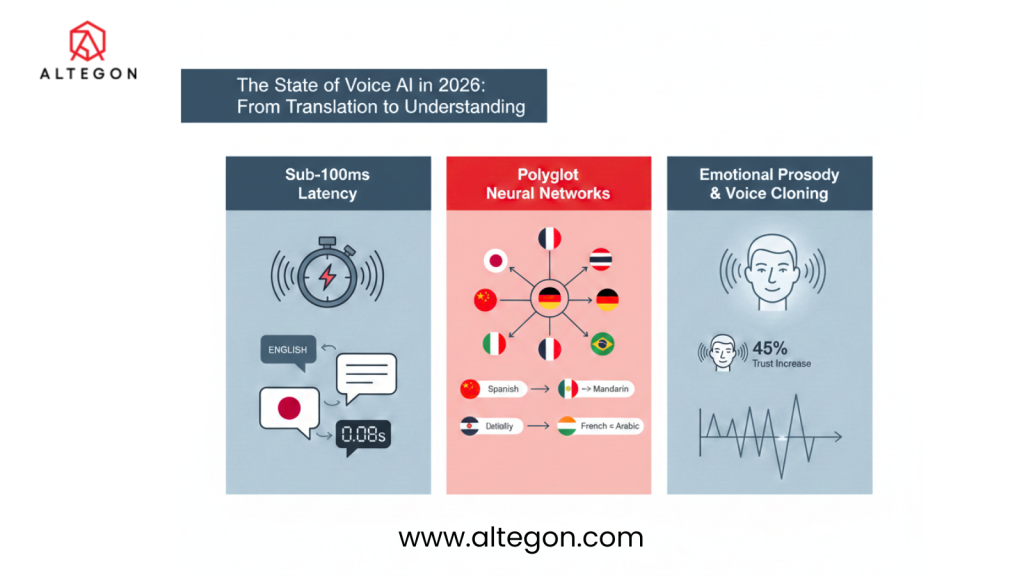
Sub-100ms Latency: Bridging the “Uncanny Valley”
Real-time Voice AI now operates with a latency of less than 100 milliseconds – faster than the human brain can perceive a delay. This allows for active interruption and a natural flow in conversation, which is critical for high-pressure brainstorming and sensitive negotiations.
Polyglot Neural Networks
Unlike older models that translated via an English “bridge” (e.g., Spanish → English → Japanese), modern Polyglot models translate directly between 100+ languages. This increases accuracy by 30% by maintaining the direct semantic relationship and intent between the two original languages.
Emotional Prosody and Voice Cloning
Research from 2025 shows that trust increases by 45% when the translated voice sounds like the original speaker. Voice AI now uses “Zero-Shot” voice cloning to replicate the speaker’s pitch, tone, and emotion in the target language. If a CEO speaks passionately in Mandarin, the English listener hears that same passion, not a robotic substitute.
How Altegon Solves the “Privacy Paradox.”
The most significant barrier to adopting AI in the enterprise isn’t the technology – it’s the security. When you use a public video conferencing tool with a translation plugin, your proprietary data is often used to train their “Global Model.” You are essentially paying a competitor to learn your trade secrets.
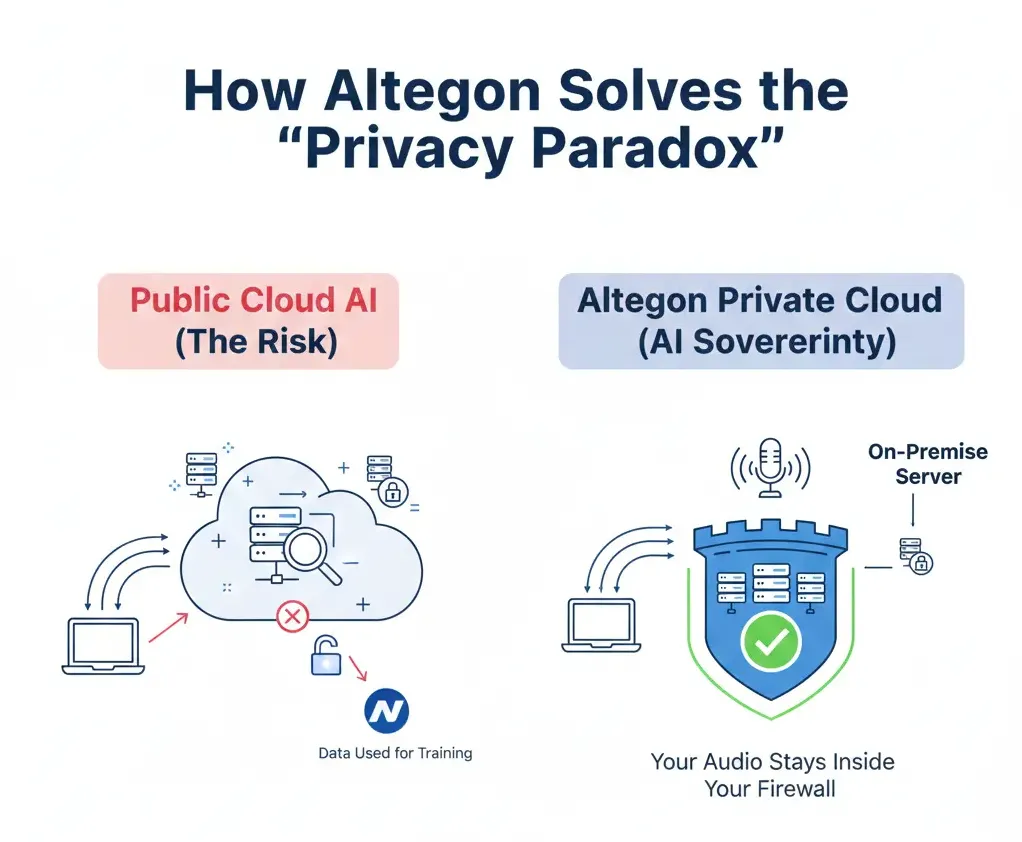
The Altegon Advantage: AI Sovereignty
Altegon changes the game by bringing the AI to the data, not the data to the AI.
- Private Cloud Deployment: Our Voice AI engines run inside your private cloud. Your audio never leaves your firewall.
- On-Premise Compatibility: For government and high-security sectors, Altegon provides the ability to run real-time translation on local, air-gapped servers.
- Zero-Knowledge Architecture: We give the pipes and the intelligence, but we never “see” or “hear” your content. Our “AI-Safe by Design” philosophy ensures your data remains yours.
Real-World Impact: Industry Use-Cases
The application of secure, real-time Voice AI is transforming how critical sectors operate on a global scale. By removing language gaps, industries can now collaborate with surgical precision.
I. Telehealth Without Borders
In a medical emergency, every second counts. Voice AI ensures that language is never a barrier to life-saving care.
- Global Consultations: A specialist in Switzerland can consult with a patient in rural Brazil in real-time.
- 99.9% Accuracy: High-fidelity translation ensures medical history and symptoms are communicated without error.
- Compliance: Fulfills the promise of decentralized medicine while remaining fully HIPAA-compliant.
II. Global Fintech and Legal
Negotiating high-stakes deals requires absolute clarity. A single mistranslated word can break a merger.
- Complex Terminology: Handles intricate legal and financial jargon between diverse regions like London and Dubai.
- Custom Lexicons: Allows firms to “feed” specific vocabulary into the AI so it never confuses terms like “escrow” with “equity.”
- Confidentiality: Ensures that sensitive negotiations stay private and secure within the Altegon infrastructure.
III. Remote Engineering and Manufacturing
Real-time AI is bringing “hands-on” expertise to factory floors thousands of miles away.
- Expert Guidance: A technician in Vietnam can receive instant, translated instructions from a senior engineer in Germany.
- AR Integration: Using AR glasses integrated with Altegon’s WebRTC SDK, translated instructions are overlaid directly on the technician’s field of vision.
- Error Reduction: Eliminates the margin for error in complex assemblies, ensuring global quality standards are met everywhere.
The Altegon Edge: Technical Excellence
At Altegon, we realized early on that “Real-Time” and “Secure” must coexist. A video platform is only as good as the privacy it guarantees.
- Minimal Latency: By optimizing the WebRTC pipeline, we ensure translation happens at the “edge,” eliminating the lag that plagues traditional APIs.
- Enterprise Lexicons: Our infrastructure allows companies to integrate their own technical dictionaries, ensuring industry-specific jargon is handled perfectly.
- Seamless UI: We believe technology should be invisible. Our interface mimics the intuitive feel of modern apps, making the transition to AI-assisted meetings feel second nature for teams.
The Road Ahead: Beyond 2026
We are moving toward a “Universal Translator” reality where “What language do you speak?” becomes an irrelevant question in business. Altegon’s roadmap includes:
- Real-Time Dialect Adaptation: Automatically switching between Latin American Spanish and Castilian Spanish based on the participant’s location.
- AI-Summarization in 50+ Languages: Providing a multi-lingual summary and action-item list to all participants immediately after the call ends.
Lets Wrap It Up!: Own Your Global Conversation
Breaking language barriers is no longer a sci-fi dream; it is a fundamental business strategy. By choosing a platform that prioritizes Private Cloud Security and Low-Latency Voice AI, you aren’t just buying a tool – you are purchasing the ability to scale your business to any corner of the globe.
The future of communication is silent on barriers and loud on clarity. Are you ready to lead the frontier? Explore how Altegon’s secure Voice AI can transform your organization today.
Frequently Asked Questions:
1. How does real-time Voice AI translation actually work?
Real-time Voice AI uses a specialized pipeline involving three main steps: Automatic Speech Recognition (ASR) to convert voice to text, Neural Machine Translation (NMT) to switch languages, and Text-to-Speech (TTS) to generate the translated audio. Platforms like Altegon optimize this using WebRTC technology to ensure the entire process happens in under 100 milliseconds, allowing for a natural, flowing conversation.
2. Is real-time AI translation secure for sensitive business meetings?
Most public tools process your audio on external servers, which can pose a security risk. However, Altegon’s Private Cloud approach keeps the AI engines within your own firewall. This ensures that proprietary data, legal discussions or patient information never leaves your secure environment, providing true AI Sovereignty.
3. Can Voice AI handle industry-specific technical jargon?
Yes. Unlike generic translation apps, enterprise-grade solutions allow for the integration of Custom Lexicons. This means you can “train” the AI to recognize and accurately translate specific medical, legal or engineering terminology unique to your business, ensuring that critical nuances are never lost.
4. What is the difference between “Cloud AI” and “Private Cloud AI”?
Public Cloud AI sends your data to a third-party provider (like Google or OpenAI) where it might be used to improve their global models. Private Cloud AI, which Altegon specializes in, deploys the AI models directly onto your private servers or dedicated cloud instances. You get the power of the AI without the data privacy trade-offs.
5. Does the translated voice sound robotic?
Not anymore. With the advent of Neural Voice Cloning in 2026, Voice AI can now replicate the original speaker’s tone, pitch, and emotional “prosody.” The listener hears the translation in a voice that sounds remarkably similar to the person speaking, which helps maintain human connection and trust during global calls.
6. How does real-time translation help with ROI?
By eliminating the need for human interpreters and reducing travel for international meetings, companies save thousands per project. Additionally, it accelerates project timelines by removing the “language bottleneck,” allowing global teams to collaborate at the same speed as local ones.