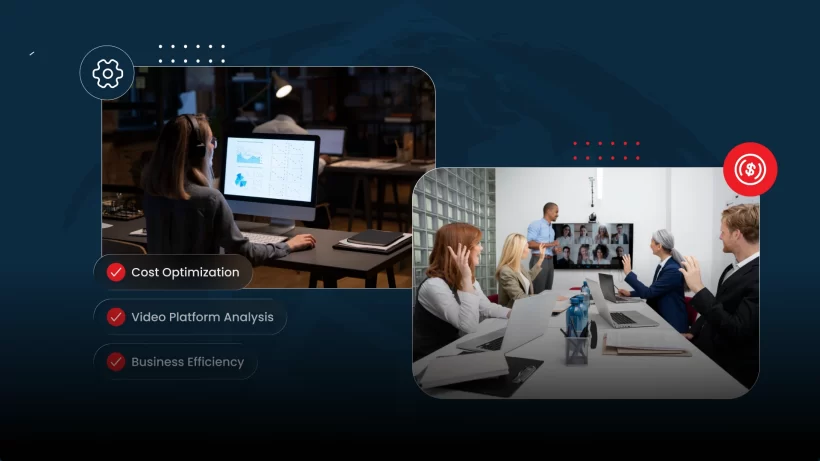
Video communication has become a cornerstone of modern business operations. Whether it’s for internal collaboration, client engagement, or knowledge sharing, organizations rely heavily on online saas video platforms solutions. While many focus on building their own custom video platform, the Total Cost of Ownership (TCO) offers a strategic perspective that goes far beyond initial investment. TCO encompasses all expenses over a platform’s lifecycle licensing, hardware, maintenance, training, downtime, and more and helps businesses make smarter, scalable, and financially stable decisions.
Understanding TCO allows businesses to align technology spending with growth goals, avoid hidden costs, ensure security, and maintain flexibility. By evaluating TCO strategically, organizations can convert technology expenses into measurable business advantages that drive efficiency, collaboration, and ROI.
The Five Critical Realizations
Before evaluating TCO factors, business leaders must understand four fundamental truths that transform video platform decision-making:
1. Think Beyond Initial Cost Consider Your Business Lifecycle: A $15/user/month subscription seems attractive with minimal upfront investment, making it easy to get started. However, successful businesses don’t operate on monthly cycles they plan for years of growth and evolution. That modest monthly fee compounds over 3-5 years into hundreds of thousands or millions of dollars with zero assets owned. Meanwhile, what appears as an “expensive” upfront investment in owned infrastructure typically breaks even within 18-30 months, after which you own valuable assets that serve your business for a decade or more. The question isn’t “what costs least today?” but rather “what delivers the most value over my business lifecycle?” Short-term thinking optimizes for quarterly budgets; strategic thinking optimizes for long-term competitive positioning, scalability, and control.
2. Data Ownership is Your Competitive Moat: Your video communications generate extraordinary strategic intelligence, customer sentiment trends predict churn, sales call patterns identify winning techniques, compliance monitoring detects violations in real-time, and operational analysis reveals efficiency opportunities. Cloud platforms either own this data or severely restrict your access, preventing AI analytics that extract competitive intelligence. When you own your infrastructure, you own 100% of your communication data, transforming it into actionable business intelligence that competitors using generic platforms cannot replicate. This data is your oil the raw material that, when refined through AI, powers strategic decisions and competitive differentiation.
3. Cybersecurity as Strategic Imperative: In an era of escalating cyber threats, security transcends IT concerns to become existential business risk. Major cloud platform breaches regularly expose confidential communications, creating regulatory fines, reputation damage, and customer trust erosion. Privately owned infrastructure provides critical security control: custom encryption, complete data residency ensuring regulatory compliance, immediate incident response without vendor dependency, zero-trust architecture, and air-gapped deployment options. Beyond compliance, superior security becomes competitive advantage customers increasingly choose providers demonstrating data protection leadership, making security posture a revenue driver.
4. User Experience as Differentiation Engine: Generic video platforms force identical experiences across all competitors you cannot white-label Zoom, customize Teams workflows for industry-specific processes, or integrate proprietary features. This commoditization makes your video interactions forgettable. Privately owned infrastructure enables complete UX control: white-labeling that reinforces your brand, custom workflows optimized for your industry, seamless integration with proprietary systems, and innovative features competitors cannot access. For customer-facing applications telemedicine, financial advisory, online education differentiated experiences directly impact conversion, satisfaction, retention, and premium pricing power.
5. Vendor Lock-In Erodes Strategic Flexibility: Cloud platforms create powerful lock-in through proprietary data formats, custom integrations, and switching costs that grow over time. Meanwhile, vendors exercise pricing power with annual increases of 5-10%, move features to premium tiers requiring upgrades, and change terms forcing operational adjustments. You’re building on rented infrastructure where the landlord controls the rules. Privately owned solutions provide strategic autonomy: you control technology evolution, can modify platforms for new business models, own perpetual access to communication archives, and maintain flexibility to innovate without vendor permission. Ownership preserves strategic optionality that subscription models systematically erode.
Total Cost of Ownership Definition
Total Cost of Ownership (TCO) is more than a sum of expenses; it’s a holistic measure of how technology impacts a business over its lifecycle. In video communication, TCO helps decision-makers understand whether each cost is simply an operational expense or an investment generating tangible business value.
A comprehensive TCO assessment includes:
- Direct Costs: Hardware, software, subscription fees, and initial deployment.
- Indirect Costs: Maintenance, energy, and network infrastructure upgrades, and IT personnel allocation costs that exist but often remain hidden in broader operational budgets.
- Hidden Costs: Downtime productivity losses, training inefficiencies, underutilized licenses, vendor lock-in penalties, and migration complexities expenses that rarely appear in initial evaluations but significantly impact total investment.
- Strategic Value Creation: Revenue enabled by platform capabilities, profit margin protection through fixed-cost economics, competitive intelligence from AI-powered communication analytics, and customer experience differentiation the positive financial impacts that transform expenses into strategic investments.
The fundamental question TCO answers: Over a 3 or more year horizon, which deployment model per-user subscriptions (Zoom, Microsoft Teams), pay-as-you-go APIs (Agora, Twilio), or privately hosted solutions delivers the lowest total cost while providing the highest strategic value? At scale and high usage, privately owned infrastructure consistently outperforms subscription models by protecting margins and enabling capabilities competitors cannot access.

Why TCO Matters in Modern Video Communication Infrastructure
Video platforms are no longer just tools for meetings; they’re the backbone of business collaboration, decision-making, and customer interaction. Failing to optimize TCO can lead to:
- Overspending on redundant licenses or outdated systems.
- Misaligned IT budgets and inefficient resource allocation.
- Security vulnerabilities and performance gaps from unmanaged infrastructure.
A robust TCO strategy ensures that every expenditure supports measurable outcomes, including higher productivity, better data security, and stronger financial returns. For organizations exploring new platforms, TCO provides a framework to compare vendors, understand cost drivers, and choose solutions that are scalable, flexible, and aligned with long-term business goals.
10 Factors That Determine the TCO?
Evaluating TCO requires a deep look at all cost components, as each can directly influence operational efficiency and ROI. Below are the ten factors businesses should consider:
1. Acquisition Costs
Acquisition costs include software licenses, hardware, and deployment services. Businesses should treat these as strategic investments, not just upfront expenses. Flexible pricing models like pay-as-you-go or per-user scaling avoid over-provisioning, Limited to zero initial investment, and ensure future scalability.
For instance, a business with 500 active users may spend differently than one planning for 5,000 users over five years; understanding this helps forecast long-term costs accurately.
2. Maintenance and Support Costs
Regular maintenance ensures consistent performance, uptime, and security. Automation and proactive monitoring reduce manual intervention, streamline operations, and minimize costly downtime. Outsourcing support or choosing cloud-native solutions can lower maintenance costs while enhancing reliability.
3. Licensing Fees
Many platforms charge per user, per month, or per feature. Auditing license usage periodically prevents unnecessary expenditures and ensures businesses only pay for what they actively use. Usage-based or scalable licensing aligns costs with actual demand, protecting ROI.
4. Operational Costs
Operational expenses include bandwidth, energy, cloud hosting, and other daily running costs. Optimizing network infrastructure and leveraging scalable cloud solutions enables predictable expenses while improving user experience and collaboration efficiency.
5. Replacement and Upgrade Costs
Technology evolves quickly. Upgrades to cloud-enabled, AI-integrated platforms ensure long-term performance, reduce operational bottlenecks, and support automation and analytics. Ignoring upgrades can increase hidden costs due to inefficiencies or outdated features.
6. Training and Documentation Costs
Even the best platform fails without adoption. Training programs, guides, and onboarding ensure employees use tools effectively. Higher adoption drives better collaboration, reduces support requests, and maximizes ROI on technology investments.
7. Downtime Costs
Unexpected downtime disrupts productivity and client engagement. Implementing network redundancy, automated failovers, and robust monitoring mitigates risks, safeguarding both revenue and operational efficiency.
8. Migration Costs
Switching platforms involves data migration, integration, and configuration. Properly accounting for migration costs prevents operational disruptions and ensures seamless transitions.
9. Scalability and Flexibility
Business needs evolve, and platforms must grow accordingly. Pay-as-you-go models, flexible scaling, and cloud-based solutions prevent vendor lock-in, ensuring cost predictability and business continuity as usage increases.
10. Security and Compliance Costs
Regulatory compliance, encryption, and security are non-negotiable. For regulated industries, security control becomes a competitive differentiator worth millions. Evaluating platform security and compliance costs upfront helps prevent data breaches, regulatory fines, and reputational damage while maintaining trust with clients and stakeholders.
Learn More : How the Flat Rate Pricing Model Builds Scalable, Data-Secure Video Infrastructure
How to Analyze the TCO of Video Communication Systems
A thorough TCO analysis is more than a technical audit; it’s a strategic business process that uncovers financial patterns, highlights inefficiencies, and aligns communication investments with long-term growth. Businesses can strengthen decision-making by approaching TCO with the following structured steps:
- Initial Cost Assessment
Build a financial baseline including licenses, hardware, deployment, and migration costs. This establishes visibility and helps forecast long-term cash flow. - Recurring Cost Evaluation
Track subscription renewals, bandwidth usage, and support expenses. Understanding recurring outflows enables smarter contract negotiations and budget alignment. - Infrastructure and Integration Analysis
Assess network scalability, security, and cloud readiness. AI-enabled platforms and seamless integrations ensure growth without inflating costs. - User Training and Support
Structured onboarding and continuous support maximize platform adoption. High adoption rates reduce downtime and per-user cost. - Cost Savings and Value Estimation
Evaluate indirect benefits like reduced travel, faster decision-making, and improved productivity. Every dollar spent should contribute to measurable business outcomes. - Holistic TCO Calculation
Combine all costs and savings to create a comprehensive TCO view. This allows leadership to optimize resource allocation, streamline processes, and improve ROI.
Need Help Calculating Your Video Platform TCO?
Calculating comprehensive TCO requires deep expertise in video infrastructure, deployment models, and long-term cost projections. Getting it wrong can lock your organization into expensive, inflexible platforms that constrain growth and competitive capabilities.
Altegon offers free TCO consultation sessions to help organizations make informed, strategic video platform decisions. Whether you’re evaluating current vendor spending, comparing new platforms, or considering build vs. buy, our experts provide objective analysis tailored to your situation.
What Our Free TCO Analysis Includes:
- Comprehensive Cost Modeling: Detailed 5-year projections across per-user subscriptions, pay-as-you-go APIs, and privately hosted solutions customized for your usage patterns and growth trajectory.
- Strategic Value Quantification: Beyond costs, we quantify business value of data ownership, security control, user experience differentiation, and vendor independence specific to your industry.
- Break-Even Analysis: Clear identification of when owned infrastructure becomes economically superior based on your actual requirements.
- Vendor-Neutral Recommendations: Objective analysis of all options to help you make the right decision, not push any particular solution.
Why Organizations Trust Altegon:
As a leader in video communication infrastructure across healthcare, finance, education, and enterprise, Altegon has helped organizations optimize millions in platform spending while enhancing security and competitive capabilities. Our comprehensive knowledge from cloud platforms to privately hosted deployments enables insights that generic consultants and vendor sales teams cannot match.
Our TCO consultation reveals: Hidden costs appearing nowhere on invoices, optimization opportunities reducing expenses 40-60%, strategic advantages of owned infrastructure for your use cases, realistic implementation timelines, and risk mitigation strategies.
Ready to Understand Your True Video Platform TCO?
Schedule your free consultation today. No obligation, no sales pressure, just expert guidance to align video infrastructure investments with business objectives.
Wrapping Lines!
Total Cost of Ownership is more than a financial metric; it is a strategic tool that informs smarter decisions, ensures scalability, and safeguards long-term ROI. Businesses, whether optimizing current platforms like Zoom or exploring new solutions, can benefit from a TCO-focused approach to select, implement, and manage video communication systems efficiently.
The five critical realizations: the profit margin trap, cybersecurity reality, AI-powered intelligence gap, and false economy of low initial cost reveal why traditional procurement thinking systematically transfers value from successful businesses to platform vendors while limiting competitive capabilities.
By considering acquisition, maintenance, licensing, operational, upgrade, training, downtime, migration, scalability, and security costs holistically, organizations can maximize value from every investment. More importantly, strategic TCO analysis captures the value creation potential revenue enablement, margin protection, competitive intelligence, and security differentiation that transforms expenses into investments generating returns far exceeding costs.
Platforms like Altegon empower businesses to achieve this balance, providing flexible, secure, and cost-efficient solutions that align technology spending with growth objectives. The difference between perpetual subscriptions that penalize success and owned infrastructure that amplifies success compounds over years into millions of dollars and sustainable competitive advantages.
Make your video communication decision strategically, not just financially. Calculate comprehensive TCO. Understand break-even points. Evaluate strategic value. Choose platforms that protect margins, enable capabilities, and position your organization for long-term success, not just what seems cheapest this quarter.