
The SaaS pricing trap happens when pricing models meant to support growth end up slowing it down. Too many tiers, unclear costs, or per-user pricing often create hidden expenses that grow faster than your revenue. The result? What looks scalable at first quickly turns into a profit drain.
According to the 2024 Flexera State of the Cloud Report, over 82% of companies overspend on SaaS as they scale, often without realizing it.
For live video platforms, this issue becomes even more severe. Every meeting, user, or stream adds another charge. This article explores why SaaS video pricing erodes margins and how you can avoid that trap by adopting a flat-rate, profit-friendly video infrastructure.
Six Hidden SaaS Pricing Traps You Should Avoid
SaaS pricing might look simple on the surface: monthly plans, user seats, feature tiers but behind this simplicity lies a web of traps that can quietly hurt your business. Many companies fall into these pricing pitfalls while trying to attract more customers or scale revenue.
Below are the most common SaaS pricing traps, explained with how they work, why they’re dangerous, and how to avoid them.
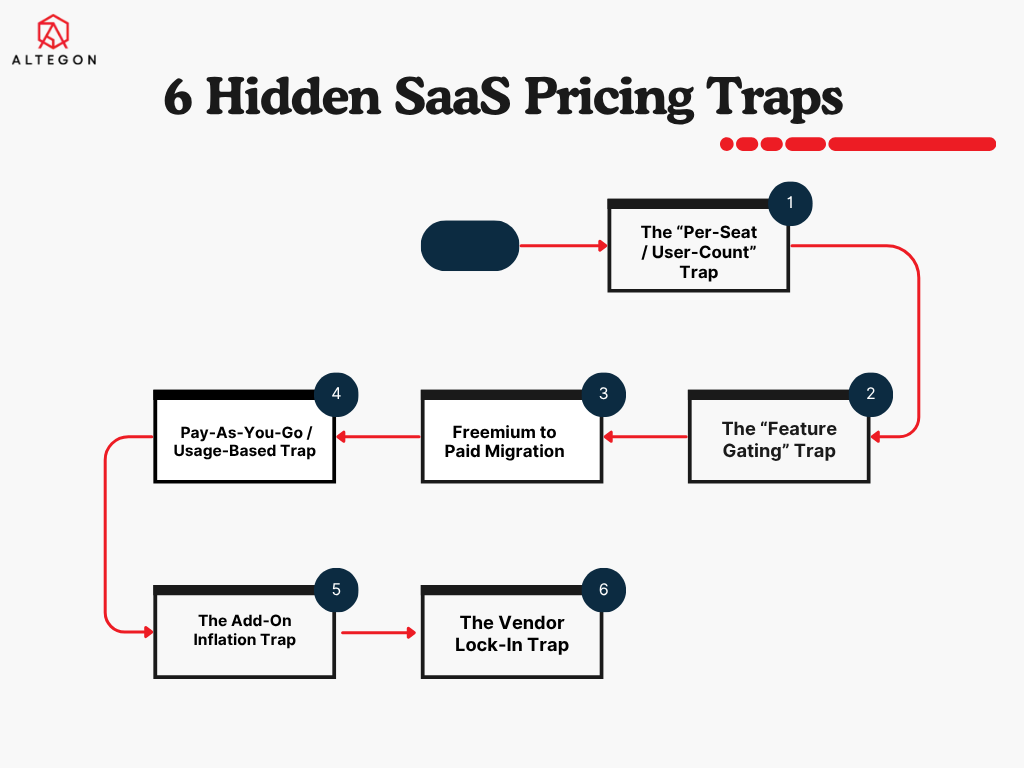
1. The “Per-Seat / User-Count” Trap
Imagine paying for every chair in your office, even the empty ones. That’s what per-seat pricing does. You’re charged for each user (or seat) in your account. It feels fair at first, but as your team expands, those costs start multiplying faster than your actual usage or value gained.
Per-seat models work well for startups entering video communication, but businesses must calculate the tipping point from day one. Ask yourself: at what user count does per-seat pricing exceed the cost of owning your infrastructure? The hidden danger isn’t just the math, it’s migration complexity.
Unlike moving from co-working to your own office, switching video platforms directly impacts your end users and revenue channels. Any disruption in that experience threatens your business continuity. If you expect exponential seat growth in the near future, this model will systematically eat your profit margins. Calculate your breaking point now, not when you’re already trapped.
Why it’s a trap:
You end up footing the bill for inactive accounts, interns who logged in once, or departments that rarely use the tool. Suddenly, the growth the thing every SaaS business dreams of becomes a financial burden instead of a success story.
| Pro Tip: Keep a close eye on who’s actually using the platform. Regularly clean up idle users, and when negotiating, ask vendors for flexible seat tiers or usage-based pricing. That way, you only pay for real activity, not virtual dust collectors. |
2. The “Feature Gating” Trap
Picture this: you sign up for a budget-friendly SaaS plan that covers your basic needs. Everything’s smooth until you need just one critical feature and surprise, it’s locked behind a premium tier. Suddenly, your affordable tool turns into an upsell machine.
Why it’s a trap:
Feature gating forces expensive tier jumps for simple needs. Imagine starting with basic features, then discovering you need 3-5 whiteboards for collaboration suddenly you’re paying 2-3X more for an entire premium tier just to unlock that one capability. Video platforms gate HD quality, recording, breakout rooms, and custom branding behind premium walls. Worse, they lock the data and insights you need to understand your own users, forcing upgrades just to access analytics. When you own the infrastructure, features aren’t ransomed back to you you control what you build and when.
| Pro Tip: Before signing up, always ask for a feature roadmap or check what’s included as you scale. Choose platforms that let you pay only for the features you need through modular add-ons instead of locking you into a full premium plan. |
3. Freemium to Paid Migration
Free plans attract users easily, but essential features or larger usage limits are locked behind paid plans, pushing you toward an upgrade.
Why it’s a trap: Freemium models scatter features across individual users with no centralized control. Take Zoom’s free tier: everyone gets local recording, meaning your business data is fragmented across personal devices. To centralize it requires massive manual effort that costs far more than the “savings.”
As a business, you lack centralized data, unified administration, or streamlined workflows from day one. When you need to scale or require business-grade features, the migration cost in both dollars and operational chaos makes the “free” period an expensive mistake. If your business model can’t sustain pay-per-use long-term, find an affordable owned solution early.
| Pro Tip: Assess the total cost of ownership from the start, not just the initial savings. Make sure the free plan truly fits your needs before scaling. |
4. Pay-As-You-Go / Usage-Based Trap:
Pay-as-you-go isn’t inherently uncalculable; most platforms provide visibility. The trap has two layers.
First, non-technical founders see the big picture pricing and subscribe without understanding the technical terminology or detailed calculations. They discover hidden costs later (switching from SD to HD or 2K video can double bills).
Second and more dangerous: you can’t predict your end users’ usage patterns. A viral moment explodes your traffic unexpectedly and your bill skyrockets overnight. Clubhouse faced this during COVID growth, scrambling to build their own solution, but by the time they finished, the wave had passed. You must decide from day one how to handle unpredictable usage spikes. With flat pricing, viral success doesn’t trigger financial panic.
5. The Add-On Inflation Trap
The starting price looks fair until you realize it’s just the entry ticket. Once you start adding the “essentials” like customer support, integrations, or compliance tools, the costs start piling up fast.The core add-ons that inflate video SaaS bills aren’t just support or compliance they’re operational necessities.
Extra storage for recordings, higher participant limits per meeting, parallel session capabilities are what businesses actually need and what drive 3-5X cost increases. Then layer on customer support, integrations, SSO, and compliance features. A $50 base plan becomes $300-400 once you add what professional video communication actually requires. Calculate total cost of ownership with all necessary add-ons before committing, not after you’re already invested.
Why it’s a trap: You think you’re signing up for an affordable plan, but the total bill ends up being two or three times higher. Suddenly, what felt like a smart deal becomes an expensive surprise.
| Pro Tip: Always ask for a complete quote before you commit. Get clarity on what’s actually included in the base plan and what’ll cost extra. A little questioning up front can save you a lot of money later. |
6. The Vendor Lock-In Trap
Some SaaS vendors make it easy to start but nearly impossible to leave. They use proprietary data formats or complex workflows that tie you to their ecosystem.Vendor lock-in operates on two levels.
First, data migration moving all recorded content, user behavior data, and integrations is complex and risky since it impacts live revenue channels. Second, feature dependency if your business needs a specific capability, you’re at the vendor’s mercy waiting for them to publish it. You can’t innovate or customize beyond their roadmap.
Without data ownership, you can’t build your own AI models or insights, forcing you to pay premium prices for their AI features instead of innovating on your own data. Data sovereignty doesn’t just prevent lock-in it enables competitive advantages that trapped competitors can never access.
Why it’s a trap: Even when prices go up or the service quality drops, moving your data elsewhere feels like open-heart surgery. It’s expensive, stressful, and time-consuming so most companies just stay stuck.
| Pro Tip: Always check how easily you can export your data before signing up. Go for vendors that are transparent about portability and use open standards. The freedom to walk away is your best leverage. |
Why Traditional Pricing Models Break at Scale & the Rise of Profit-Friendly Infrastructure

Even the cleanest pricing strategy can collapse when costs scale faster than revenue. Live video communication platforms often face this when they rely on per-seat or per-minute pricing. What seems flexible at first quickly becomes unpredictable as usage spikes eating into margins instead of expanding them.
- Per-seat and per-minute models punish growth. Every new user, stream, or participant increases costs linearly, even if revenue doesn’t. This creates a reverse-scaling problem where higher engagement actually reduces profit.
- The cost-scaling curve favors flat-rate models. Off-the-shelf SaaS tools grow expenses exponentially as usage rises, while flat-rate infrastructure keeps costs predictable regardless of scale. The result is healthier profit retention and easier forecasting.
- Profit-friendly infrastructure prioritizes stability. A flat-rate, usage-agnostic system gives teams confidence to grow without fearing hidden spikes. It transforms pricing from a risk factor into a strategic advantage where every new customer strengthens margins instead of squeezing them.
Learn More: The Rise of Self-Hosted Video Platforms in a Privacy-First World: When to Choose Them
How Flat-Rate Infrastructure Reshapes Growth Metrics

Growth isn’t just about more users, it’s about smarter scaling. For platforms running on traditional SaaS pricing, each new meeting or minute used increases cost faster than revenue. Flat-rate video infrastructure changes that equation entirely, turning usage from a liability into an asset.
With Altegon’s flat-rate model, companies no longer chase growth while fearing their next billing cycle. Instead, they gain predictable cost structures that transform financial planning and product strategy.
- Stable Margins: Revenue grows while infrastructure costs stay constant. CFOs can forecast with accuracy instead of battling usage spikes.
- Higher Retention: Clients and users stay longer when pricing predictability builds trust especially for telehealth, SaaS, and entertainment platforms.
- Faster ROI: No per-seat penalties mean teams can scale users, not expenses. Many Altegon clients reach break-even 40% faster compared to usage-based tools.
- Data-Driven Intelligence: Full data ownership unlocks new KPIs engagement analytics, sentiment insights, and automated performance metrics that generic video APIs can’t provide.
- AI-Ready Foundations: Altegon’s infrastructure doesn’t just reduce costs; it prepares platforms for the next phase of intelligent automation and real-time analytics built on owned data.
In short, flat-rate video infrastructure doesn’t just reshape metrics it redefines what profitable growth looks like. For SaaS and telehealth leaders across the US, Europe, and the Middle East, Altegon provides the foundation to scale freely, securely, and intelligently.
Case Study: How Flat-Rate Video Infrastructure Turned Cost Chaos into Scalable Growth
Let’s look at how a mid-sized SaaS platform transformed its pricing model and restored profitability by simplifying its live video infrastructure.
Before: The Cost Spiral Problem
A fast-growing telehealth company in Sheridan, Wyoming relied on a pay-per-minute video API for virtual consultations. Their platform hosted hundreds of sessions daily but their costs scaled faster than their revenue.
They faced:
- 180% increase in video costs within a year
- Unpredictable monthly bills ranging from $12K–$30K
- 55% of CFO time spent analyzing usage reports
- Slowing user adoption due to session time limits
The per-minute model meant success was expensive the more patients they served, the less they earned.
The Transformation Process
The company partnered with Altegon to rebuild its video infrastructure with a flat-rate licensing approach.
Here’s what changed:
- Simplified Infrastructure: Altegon integrated a white-labeled, HIPAA-compliant live video layer directly into their platform.
- Flat, Predictable Costs: One organization-wide license replaced the unpredictable usage bills.
- Full Data Ownership: All meeting data stayed within their environment, unlocking AI-based insights like patient engagement and provider performance.
- Zero Downtime Migration: The transition was completed in under 45 days without impacting live operations.
After: Results of Simplification
Within six months of switching to Altegon’s flat-rate model, the impact was clear:
- 32% increase in patient session volume
- 48% drop in infrastructure-related expenses
- ROI achieved in just 4.5 months
- 60% faster go-to-market time for new telehealth features
- Zero pricing-related support tickets
What began as a cost-control move evolved into a strategic growth advantage.
The company now scales freely, with stable margins and complete visibility into its video data all while maintaining regulatory compliance and user trust.
Wrapping Lines!
In the SaaS world, growth shouldn’t come at the cost of predictability. Complex pricing structures and fragmented infrastructure often erode both trust and profit margins. By moving toward flat-rate, transparent, and scalable models, companies can regain control over their growth metrics.
Platforms adopting this approach like those powered by flat-rate, data-sovereign infrastructures such as Altegon are proving that simplification isn’t a downgrade. It’s a smarter, more sustainable way to scale profitably.
Frequently Asked Questions
1. What exactly is flat-rate video infrastructure?
Flat-rate infrastructure means you pay a single predictable cost, regardless of usage or user count. It eliminates per-minute or per-seat billing, the main reason SaaS video costs spiral out of control as platforms scale.
2. Does simplifying pricing mean losing revenue potential?
Not at all. When done strategically, simplification increases trust and conversion rates. With the right structure supported by customer research and behavioral insight you can often earn more through clarity and reduced friction.
3. How does flat-rate infrastructure improve SaaS growth metrics?
Predictable pricing stabilizes gross margins, reduces churn anxiety, and improves LTV-to-CAC ratios. In short, it replaces variable infrastructure costs with fixed, forecastable ones letting teams invest confidently in growth.
4. How does Altegon’s model differ from traditional video API providers?
Unlike per-minute or per-user models from typical SaaS vendors, Altegon’s flat-rate infrastructure provides full data ownership and organization-wide licensing. That means your video usage can grow without eating into your margins a critical advantage for scaling platforms.
5. Is flat-rate infrastructure suitable for regulated sectors like healthcare or finance?
Yes. Altegon supports HIPAA, GDPR, and SOC 2 compliance with fully controlled deployments. You decide where and how your data is stored ensuring privacy, sovereignty, and future AI readiness.
6. Can flat-rate models work for startups, or only enterprises?
Startups benefit just as much, especially those planning for scale. Early adoption of flat-rate infrastructure avoids the painful “cost explosion” that comes once user activity ramps up.
7. How can a company transition from per-usage billing to flat-rate infrastructure?
Start by auditing your current video usage and cost patterns. Identify your average monthly usage, and compare that with a fixed-cost licensing model. Altegon’s team assists companies through this transition from discovery to migration ensuring cost-neutral or positive outcomes from month one.8. What’s the real ROI of simplifying pricing and adopting flat-rate models?
Companies typically see measurable gains within the first 3–6 months including lower churn, faster conversions, and up to 40-60% savings in operational video costs. The predictability itself becomes a strategic asset.