Video is no longer a supporting feature in SaaS products. For many platforms across collaboration, telehealth, education, sales enablement, and AI-driven workflows it has become part of the core product experience.
Most SaaS teams start the same way: they integrate a third-party video API. It’s fast, proven, and reliable.
The challenge doesn’t appear on day one. It appears at scale.
As usage grows, costs rise in ways that are hard to predict. Margins tighten. Feature roadmaps slow down. And eventually, teams are forced to rethink their entire video layer often at the most critical stage of growth.
This is where the conversation shifts from using video infrastructure to owning it.
What Does It Mean to Own Video Infrastructure?
Owning video infrastructure does not mean rejecting third-party platforms or questioning their stability. It means making a strategic decision about control.
When a SaaS company owns its video layer, it controls:
- How media is routed and processed
- How costs scale with usage
- How data is accessed for AI workflows
- How privacy, compliance, and security are enforced
This ownership can include:
- A dedicated WebRTC media stack or SFU optimized for the product
- Custom signaling and session logic
- Private recording and storage pipelines
- Direct access to raw audio, video, and metadata
The goal is not speed at any cost. The goal is sustainable scale.
| Did You Know?According to industry research, as API usage grows, hidden costs such as per-call charges, bandwidth, retry overhead, and data transfer can quickly become one of the biggest budget line items for SaaS companies, often costing tens of thousands of dollars per month if not carefully managed. |
Why Video Costs Quietly Erode SaaS Margins
For early-stage products, third-party video APIs make sense. They reduce complexity and accelerate initial launches.
But as a platform scales, cost dynamics change.
Most commercial video APIs charge across multiple dimensions:
- Per participant
- Per minute
- Recording and storage fees
- Playback and bandwidth costs
- Premium pricing for exports and advanced features
At low volumes, these costs feel manageable. At scale, they start cutting directly into margins.
This is where many SaaS companies hit a wall:
- Revenue grows, but profitability stalls
- Forecasting becomes harder
- Video usage becomes a cost center instead of a growth driver
Eventually, teams are forced into a second phase: re-architecting their video stack. That transition is expensive, time-consuming, and often delays new feature launches.
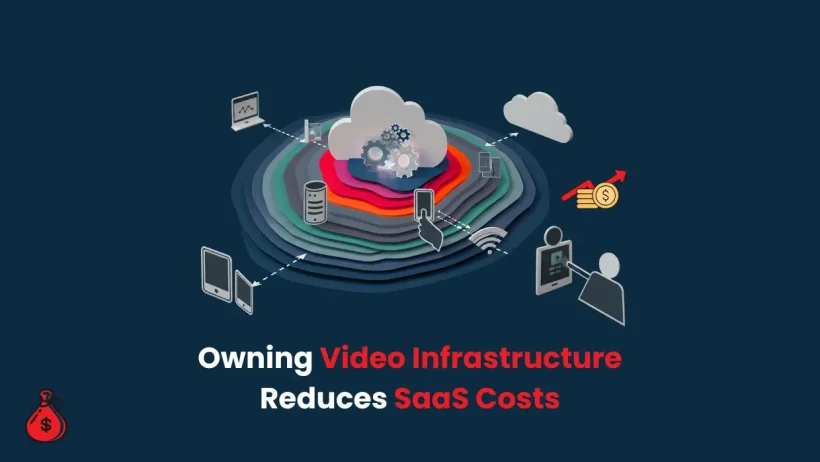
Owning video infrastructure earlier in the growth curve helps avoid this cycle.
By controlling routing, codecs, compute usage, and storage, companies can align video costs with actual business value instead of unpredictable usage spikes.
Understanding how to optimize costs goes beyond infrastructure. You can also learn about common pitfalls in SaaS monetization in our article on the SaaS Pricing Trap.
Speed to Market: Starting Fast vs. Staying Fast
“Speeding up launch” is often misunderstood.
Yes, integrating an API is fast. But speed in SaaS is not just about the first release.
True speed includes:
- Security and compliance approvals
- Enterprise procurement requirements
- Regional data regulations
- Long-term scalability without rework
Many teams launch quickly, then slow down later when:
- Compliance requirements increase
- Costs force architectural changes
- Infrastructure limits block new features
Ownership changes this dynamic.
When you control your video infrastructure, future launches become faster because:
- You are not blocked by vendor roadmaps
- Compliance and security are built into your architecture
- New workflows don’t require renegotiating platform constraints
In simple terms:
Starting fast is easy. Staying fast is strategic.
The Third Dimension: AI Changes Everything
Video infrastructure was once considered a human-intensive operational problem. Monitoring, scaling, optimization, and troubleshooting required dedicated teams.
That reality has changed.
Today, AI agents manage large parts of infrastructure operations:
- Auto-scaling based on real-time demand
- Quality monitoring and anomaly detection
- Intelligent routing and optimization
- Predictive fault detection
What once required teams now runs on intelligent systems.
This shift makes ownership far more practical than it was in the past.
Data Ownership Unlocks Real-Time AI Intelligence
When you own your infrastructure, you own your data.
That includes:
- Raw audio and video streams
- Metadata and session signals
- Behavioral patterns across users
This data fuels real-time AI insights:
- How users actually communicate
- Where friction appears in workflows
- What impacts engagement, conversion, and retention
Generic platforms understandably limit access to this depth of data.
Ownership allows AI to work with your product, not around it.
Privacy, Compliance, and Control by Design
AI and data ownership naturally lead to privacy considerations.
Owning your video infrastructure gives you control over:
- Data routing and residency
- Retention policies
- Encryption and key management
- Model training boundaries
This is not about fear. It’s about decision power.
When you own the infrastructure, you decide how data is stored, processed, and exposed to AI systems making compliance with GDPR, HIPAA, and enterprise security requirements simpler and more predictable.
For a deeper look at why real-time communication is becoming the next competitive edge, check out our insight on how voice is emerging as the latest AI battleground.
Why Altegon Fits This Shift
This is the environment Altegon is built for.
Altegon helps SaaS companies move from dependency to ownership without turning infrastructure into a burden.
By combining:
- Enterprise-grade real-time communication
- AI-native workflows and insights
- Strong privacy and compliance foundations
- Flexible, product-first customization
Altegon enables teams to own their video layer while staying focused on what matters most: building and scaling their product.
Instead of forcing your roadmap to fit someone else’s platform, Altegon adapts to your architecture, your data strategy, and your growth stage.
Wrapping Lines!
Video is no longer just another integration. It is part of how SaaS products operate, scale, and differentiate.
Owning video infrastructure is not about rejecting proven platforms. It is about recognizing when control, cost predictability, AI intelligence, and privacy become strategic advantages rather than limitations.
For growing SaaS teams, this shift often marks the difference between reacting to scale and being ready for it.
This is where Altegon fits naturally into the journey. Altegon enables SaaS teams to move toward infrastructure ownership without slowing innovation or increasing operational complexity. By combining enterprise-grade real-time communication, AI-native capabilities, and strong privacy foundations, Altegon helps teams build a video layer that scales with their product, not against it.
Frequently Asked Questions (FAQs)
- Is owning video infrastructure better than using third-party video APIs?
Owning video infrastructure gives SaaS companies greater control over costs, data access, AI workflows, and privacy. Third-party APIs are useful for early launches, but ownership becomes more valuable as scale and complexity increase. - Does owning video infrastructure slow down SaaS product launches?
No. While API integrations can speed up initial launches, owning infrastructure helps teams stay fast long term by avoiding re-architecture, compliance delays, and vendor limitations as the product grows. - Is owning video infrastructure expensive for SaaS startups?
Owning video infrastructure may require upfront planning, but for growing SaaS companies it often reduces long-term expenses by eliminating unpredictable per-minute fees and aligning costs with actual usage. - How does owning video infrastructure support AI-driven features?
Ownership provides access to raw audio, video, and metadata. This allows AI systems to analyze real-time communication signals, improve user experience, and generate insights around engagement and performance. - Why is data privacy stronger with owned video infrastructure?
When SaaS companies own their video layer, they control data routing, storage, encryption, and retention policies. This makes meeting GDPR, HIPAA, and enterprise security requirements more predictable. - When should a SaaS company consider owning video infrastructure?
SaaS teams typically consider ownership when video becomes central to their product experience, costs start impacting margins, or AI and compliance requirements increase. - How does Altegon support SaaS companies transitioning to owned video infrastructure?
Altegon helps SaaS companies move from dependency to ownership by providing enterprise-grade real-time communication, AI-native insights, privacy-first architecture, and flexible customization that adapts to different growth stages.